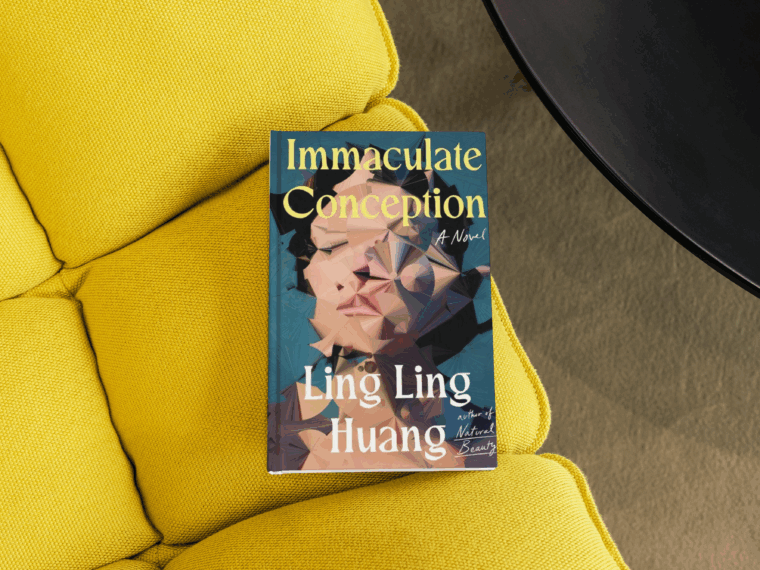
Immaculate Conception by Ling Ling Huang paints a vivid portrait of the art world and friendship, and of our consumption and perception of each.
Immaculate Conception by Ling Ling Huang: Synopsis
Huang introduces us to Enka, an ambitious artist seeking an art career, who, despite her low-class status and lack of training and education, accomplishes the impossible and lands a scholarship at a prestigious art school.
Despite her struggles to fit in and be accepted by the wealthy elites, she stumbles into a friendship with the talented artist, Mathilde. They form a close bond after Enka helps Mathilde through a dark mental health period. But when Mathilde later begins to make a splash in the art world, leaving Enka behind, her obsessive admiration turns into envy, creating a silent competition and a need to reach similar success and accolades.
Enka charts a different path and approach to her art by becoming the wife of a successful innovator who has invented a powerful device, the SCAFFOLD, that can link the minds of two humans to treat and address trauma. Enka leaps at the chance to test-drive this new technology to help Mathilde treat her trauma.
What happens is a heartbreaking journey of self-discovery, identity, and radical self-acceptance that will change both Enka’s and Mathilde’s lives and friendship forever.
Immaculate Conception by Ling Ling Huang Book
 Genre: Horror, Speculative, Literary
Publication: May 13, 2025
Author: Ling Ling Huang is a writer and violinist. Immaculate Conception is her second novel, with Natural Beauty being her first.
Themes: art, authenticity, exploitation, friendship, envy, identity, ethics of technology in art and creation, classism and elitism in the art world, trauma, creativity, and bodily autonomy.
Content/Trigger Warnings: suicide, suicidal ideation, self-harm, body horror, death, grief, sexual assault, molestation, mental health, depression, ableism
Immaculate Conception by Ling Ling Huang Review
Craft & Style
Huang doesn’t stray from her traditional writing style. She delivers a thought-provoking novel full of rich commentary on art, the commodification of art and artists by wealthy elites, and how a friendship quickly becomes toxic as jealousy and envy take hold.
The pacing of this novel was steady, as it balanced plot-driven and character-driven elements. We start with a conflict that propels the first half of the book forward as we alternate between past and present timelines, gaining context on Enka and Mathilde’s friendship and what led to this point.
It then enters another conflict that continues to expand until the novel’s climactic conclusion.
Huang’s commentary felt more well-balanced in this novel. She wasn’t as heavy-handed or forceful in pushing a particular narrative at you. But allowed space for you to interpret the author’s message without being told explicitly what she’s driving at.
When it comes to the structure, the juxtaposition of Mathilde and Enka was masterful and highlighted not only the deeper themes of identity, envy, and obsession with different creative approaches and beliefs about originality, inspiration, and what constitutes good art. This approach made it feel as if Huang were opening the door to an exploratory conversation about these topics and their current impact on art and creative spaces.
Emotional Impact
I had such visceral reactions to this novel’s content. Enka’s behaviors, actions, and thought processes were troubling to witness, and it was hard to be in her head. While I wanted strongly to root for her, I also found myself yelling at her.
Her identity struggles and insecurities are palpable and oftentimes troubling, considering how they usually trigger an unhealthy reaction that has damaging consequences on those around her.
Additionally, the themes in this novel led me to consider how I view, approach, and understand art and creativity regarding ownership, inspiration, and the classic debate over originality.
I found Mathilde’s struggles with mental health relatable and accurately depicted, and I appreciated how they were reflected in her art and served as inspiration for many of her pieces. However, the mental health aspects may be triggering for some, so take this with a grain of salt.
Representation
Ling Ling Huang is an Asian American author, and her lived experience navigating diversity, race, and being a first-generation immigrant provides a non-white, non-mainstream perspective.
Characters Enka and Mathilde are described as Asian. Still, little focus is placed on the racial identifiers of characters, as Huang prioritizes themes regarding class as another form of prejudice and oppression. Leaving race to be intuited by the reader.
Additionally, characters in the story represent the LGBTQIA+ community through their sexuality or gender presentation.
Huang also explores the class/privilege divide, represented by those who live in “fringe” neighborhoods, which make up the lower/underprivileged class, and those who live in “enclave” communities, which represent the upper/privileged class.
We see how these classifications affect job opportunities, education, housing, the community’s ability to access the arts online, and the presence of museums and other institutions, while omitting any mention of culture or art in these communities and silencing their voices by denying access to this form of self-expression.
Notable Strengths
Where this novel shines is its brilliant commentary on its various themes. Huang has a lot to say, and while the book covers multiple themes, its structure and pacing allow you to experience each one and see these storylines intersect, exploring its central theme: art and creation as forces impossible to commodify or control.
Potential Challenges
Enka may be tough for many readers to connect with and even root for. She quickly becomes the underdog from the fringe that you’re rooting for, to an entitled social climber. The depths of her envy, manipulation, and one-sided competition become hard to witness and follow as the plot thickens and tensions increase.
Deeper Reflection
Huang also explores how Generative AI and Generative Art affect artists and challenge our understanding of originality, inspiration, and creativity. Consider how Generative Art has impacted the art community worldwide. Do you believe it’s diminishing the need for art, artists, and stifling creativity?
Who Do I Recommend This To?
This novel feels like a love letter to artists and creatives and would be a thought-provoking book for readers with a background or interest in art. It’s also an excellent pick for readers who want to explore themes regarding toxic female friendships, codependency, identity crisis, imposter syndrome, classism, and the commodification of art.
Join the Conversation
Have you ever been in a toxic, competitive friendship that led you to do unthinkable things to get ahead? If so, what? Share in the comments.